
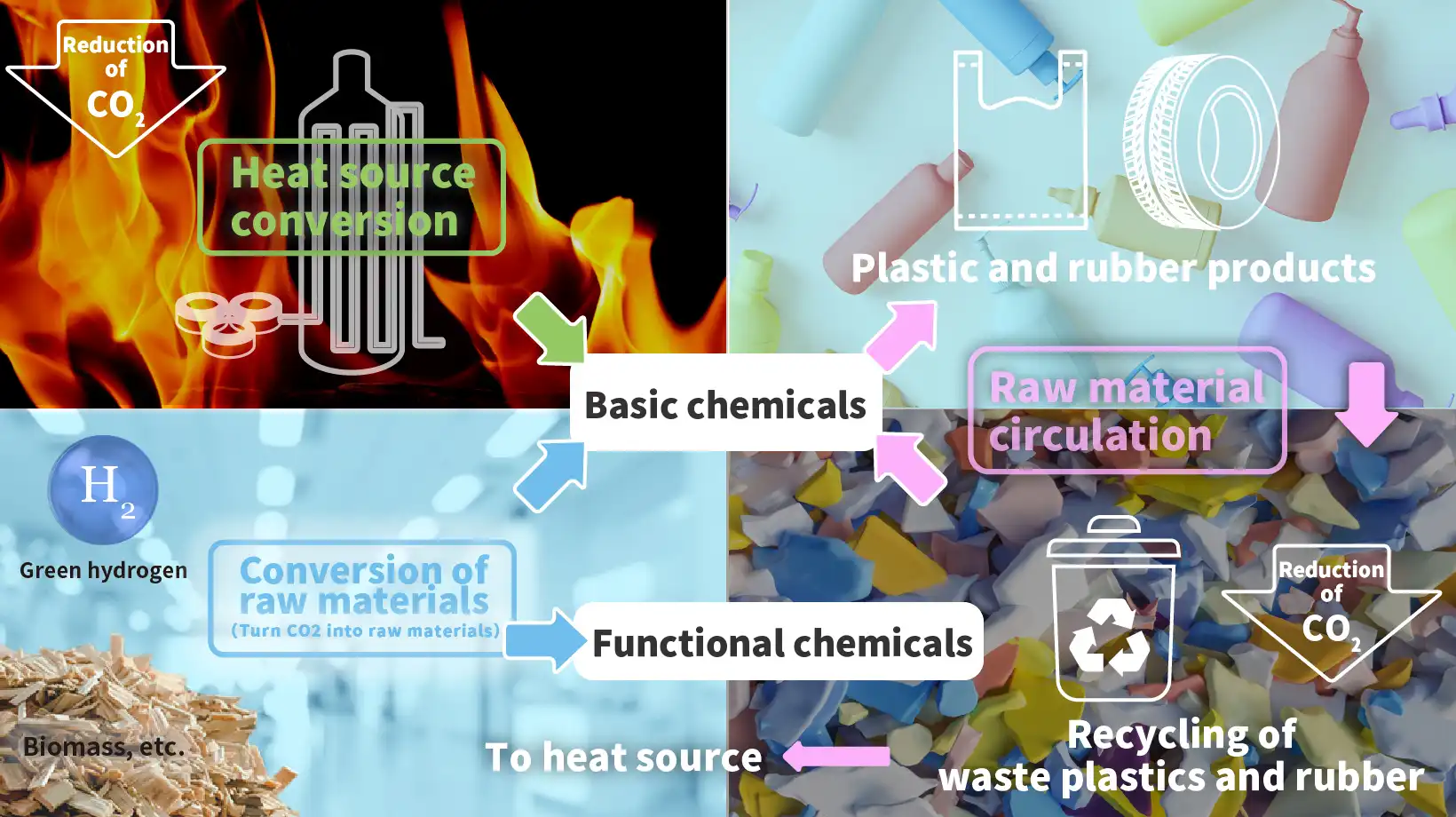
Carbon Recycling is a key technology that effectively utilizes CO2 as a resource for realizing a carbon neutral society. As of 2019, the industrial sector accounts for 29.3% of total CO2 emissions in Japan, and the chemical industry, which accounts for 18.6% of the industrial sector, emits 60.18 million tons on an annual basis.
Most of the raw materials for plastics are derived from naphtha (crude gasoline), which is obtained from refining petroleum, and about half of the CO2 emitted by the chemical industry is due to processes like cracking naphtha to produce basic chemicals such as ethylene and propylene.
In addition, about 84% of waste plastics are recycled, but some 57% of these are used as a heat source for waste-to-energy plants, etc. (thermal recycling), and are eventually discharged as CO2. So drastic measures are therefore necessary.
The aim of this project, therefore, is to develop four carbon recycling technologies related to the manufacture of plastic raw materials: advanced technology for naphtha cracking furnaces by adopting carbon-free heat sources, technology for producing chemicals from waste plastics and rubber, technology for producing functional chemicals from CO2, and technology for producing chemicals from alcohols.